


It’s a long historical academic debate about why so many marketing and military terminologies resemble and are inter-changeably used e.g. Brand warfare, goals, targets, objectives, positioning, impact, action, intelligence, strategy, tactical moves, attack strategies (frontal, flank, guerrilla, encirclement & bypass), position strategies (position strategy, contraction strategy, counter-offensive strategy, preemptive defensive strategy, and mobile defensive strategy), and latest is marketing hybrid integration.
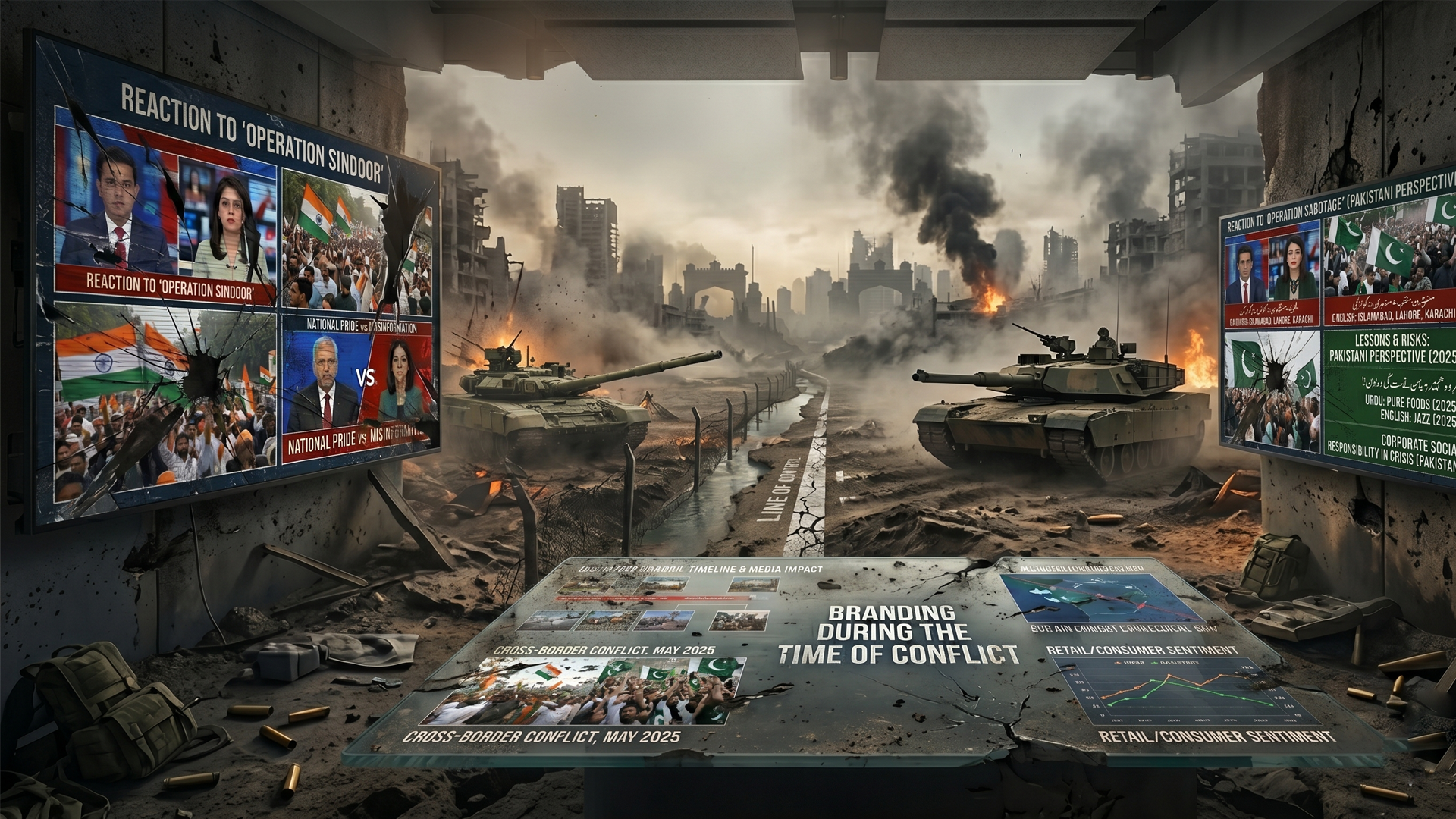
Upon completion of a full year, the following is now very much evident. In May 2025, India launched “Operation Sindhoor” against Pakistan. This is one of the first military conflicts in history in which a designated and well-crafted logo with all branding elements was used. This logo was used across the media, in every communication, whether it was a press conference by the Indian military officials or TV channels.
Pakistan also named its military operation “Bunyan-ul-Marsoos” (Iron Wall), but it is more religious in its zeal and spirit and lacks a specific logo.
Description of Operation Sindoor Logo:
According to the New York Times, “Sindoor” (also called vermilion powder) is a traditional red or orange-red cosmetic used in Hindu culture. It is commonly associated with marriage, and many married Hindu women apply it in the parting of their hair (maang) or sometimes on the forehead as a symbol of being married and wipe it off if they become widowed. During the April 22 terrorist attack, many women lost their husbands, who were targeted because they were Hindu.”
Marketing Question:
A strategic marketing and advertisement guru from Pakistan, Abbas Alam, who brings two decades of experience, pointed out that “not just any logo, but a proper, well-designed one. And if you looked closely at the name of the war, it felt like it had been crafted keeping a target audience in mind the kind of naming you’d expect from a marketing brainstorm, not a military command room”.
Advertisement Brief:
Abbass Alam raised many questions: “Think about it: Someone must’ve written a brief outlining the objective, target segments, tone, and desired response. A creative team might’ve sat in a room, sketching out visuals, creating campaign directions, and preparing design options. Revisions would have happened. Clients might’ve asked for tweaks.
A final rollout plan would have been approved.”
He also asked, “Is signing a war like a marketing campaign, okay? Is it ethical to treat something so devastating with the same mindset we use to sell toothpaste or mobile phones?”

Objectives:
Many marketers also asked, ‘Is that a War logo or part of any post-war political campaign?’ This seems correct, as Indian Prime Minister Mr. Modi used an operational name in the election campaign for the upcoming elections in many Indian states.
This logo’s target market seems not to be the Indian enemy (Pakistan) but the state’s voters, where elections were to be held soon.
When the operation’s name was announced, various Bollywood film production houses raced to register or acquire the legal rights to “Sindoor” for their upcoming movie. So, it was more about a commercial purpose in the name of patriotism rather than the sincerity and seriousness of war.

Emotional Resonance:
This logo comprises the tradition of the Hindu religion as well as the sentimental call for a typical Indian who believes in the Indian government’s narrative and actions. “It seemed crafted not just for tactical purposes but for emotional resonance. In many ways, it was a psychological campaign: an attempt to project power, moral authority, and cultural depth through a single, memorable label,” a few marketers added.
Ethically, is War Branding Correct?
It also seems that this type of branding initiates ‘war hysteria, which is equally hazardous for both sides of the neighboring countries.

Role of Pakistani Media:
As a nation, Pakistan faced the aggression of a three-times larger military power. During crises, the overall attitude of Pakistani brands and primarily the media was not based on hate, jingoism, and hostility, as was reflected in the Indian media.
Although almost all Pakistani TV Channels changed the color of their logos on screen, aligning them with the national flag, unlike Indian media, Pakistani electronic media strengthened national unity, avoided war hysteria and jingoism, and provided its audience with correct, authentic, and verified news and analysis.

Many Pakistani marketers have reservations about this branding, and they talked neutrally and logically. Moomna Saghir founder of Brix, added, “It raises ethical questions about how far the principles of marketing can or should be stretched. This comparison forces us to reflect on the power of language and imagery in shaping narratives, especially when those narratives influence such serious, high-stakes outcomes. It makes you wonder, where we draw the line between communication as a tool for shaping perceptions and communication as a tool for manipulating actions.”
The most important and positive sign was that Pakistani channels didn’t indulge in the TRP war or any competition with “Breaking News”. Due to continuous false claims and fake reporting during the war, the Indian media (with 400+ channels) turned into a symbol of humiliation across the world. They were the real culprits who pressured the government to enter the war and create an atmosphere of chaos and instability in the region. In contrast, Pakistani media appeared sober and cautious about the news.
Pakistani marketers have reservations about this branding, and they talked neutrally and logically – Moomna Saghir

Role of Pakistani Brands:
Pakistani brands also reflected patriotic sentiments and avoided panic or jingoism. They promoted faith in Pakistan and reflected patriotic messages. KFC, which was hard hit by the boycott campaign, changed its logo to green and later offered a special discount deal.
Whether to promote any hate and war sentiments, various Pakistani brands offer special discounts and promo codes based on the success of Pakistani warplanes. Yes, they hard hit the Indian’s Rafael performance in a lighter note, just like the ‘Fantastic Cup of Tea’.


Humor in Crises, another Positive Spec of Pakistani Gen-Z:
During absolute crises, Pakistani youth appeared as ‘Masters of Memes’, broadly without using any abusive language, and they took this period on a lighter note. They didn’t reflect any sign of fear or disturbance against the mighty Indian power. They stood firm and humiliated Indian war fever into much lighter notes.

OOH – A War Inside:
It seemed that after peace, various political leaders, administrative authorities, and real estate brands flooded the OOH with visibility.
It seemed more artificial, and the race of “Number Banana” rather than any patriotic symbol.
Critics call it a PR stunt, and it’s happening on both sides of the border.
Alhamdulillah, the Pakistan armed forces performed remarkably well in a time of need when our traditional enemy threatened the sovereignty and dignity of the nation. Pakistani authorities, unlike our neighbor, didn’t symbolize their military operation in broad economic, political, and commercial motives.
Serious segments of society do not appreciate the use of branding in wars. Wars should not be glorified. It’s a costly exercise for both sides. Still, as Pakistanis, we proved that despite our sectarian and political differences, if someone challenged our sovereignty, we stood united and firm like an iron wall, behind our armed forces, who never let us down.