

Pakistan’s OOH Market Resilience and It’s Digital Reckoning
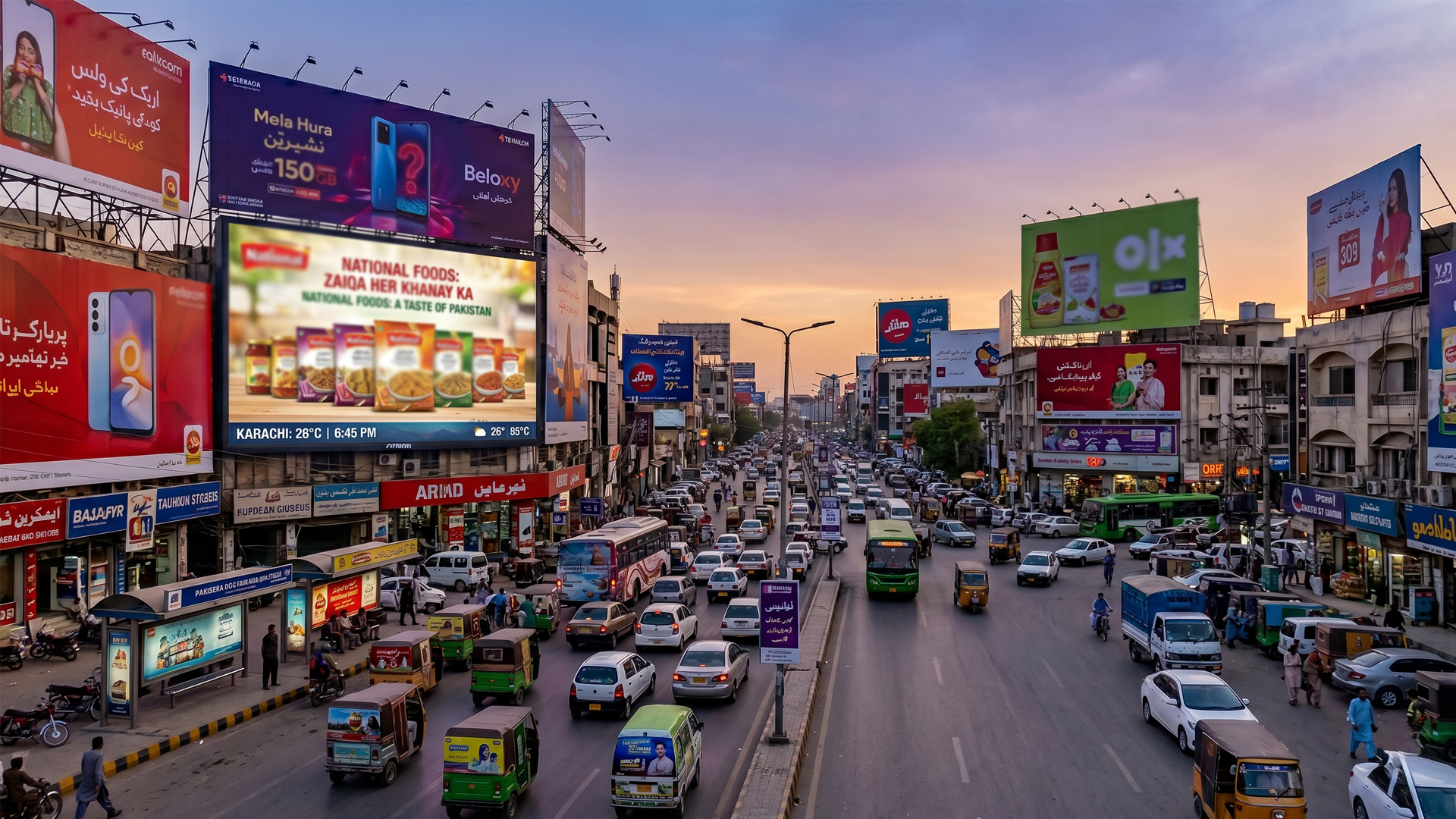
Out-of-home advertising in Pakistan has quietly become one of the most resilient segments in the country’s advertising economy — surviving a pandemic, absorbing inflation, and posting some of the strongest growth figures in traditional media. The numbers tell a story that the industry largely underreports.
The Pandemic Dip and the Rebound
Pakistan’s total advertising revenue fell from PKR 87.7 billion in FY17 to PKR 58.6 billion in FY20. A contraction driven by economic headwinds and COVID-19 disruption. OOH took a hit alongside every other medium. But the recovery was swift. Government business-friendly policies led to a surge in advertising revenue, pushing the total to PKR 75.64 billion in FY21. Within that rebound, OOH was among the strongest performers by growing 42% with PKR 2.5 billion in incremental revenue.
2022: OOH Leads Traditional Media Growth
The momentum carried into 2022. OOH recorded the strongest growth forecast among traditional formats at +10%, ahead of television at +5%, radio at +4%, and print at -1%. This was not coincidental; post-pandemic mobility returned, urban footfall recovered, and brands that had pulled back on outdoor were returning with urgency to reclaim physical presence.
FY24: A PKR 14+ Billion Market Concentrated in Five Cities
The most detailed picture of Pakistan’s OOH market comes from PACRA’s February 2025 Media Sector Study. OOH commanded a 14.9% share of total advertising revenue in FY24, making it the third-largest medium after TV and digital.
Geographically, the market is heavily concentrated. OOH revenues for the top five cities stood at PKR 6.0 billion for Karachi, PKR 5.3 billion for Lahore, PKR 1.3 billion for Rawalpindi/Islamabad, PKR 1.1 billion for Faisalabad, and PKR 1.0 billion for Multan. Five cities account for the overwhelming bulk of the entire national OOH spend; every other market is effectively a rounding error.
Who Is Spending and on What
Real estate dominated OOH spending with a 25.7% share, followed by beverages at 15.2% and FMCGs at 11.1%. The real estate dominance is telling. It reflects both the sector’s aggressive growth phase through the decade and OOH’s effectiveness in driving location-based awareness for property launches, a use case that digital simply cannot replicate at scale.
Format-wise, billboards and building wraps together accounted for 73% of total OOH advertising revenue in FY24, confirming that despite the global push toward digital OOH (DOOH), Pakistan’s market remains overwhelmingly traditional in format.
The DOOH Gap
This is where Pakistan diverges sharply from regional and global trends. The global OOH market is projected to grow at a CAGR of 8.1% through 2032, driven largely by digital transformation, data-driven targeting, and programmatic adoption. Pakistan’s DOOH infrastructure remains nascent, concentrated in a handful of screens in Karachi and Lahore, with no standardised measurement framework and limited programmatic capability.
The effectiveness gap is real. Pakistani OOH still relies heavily on impression-based justification rather than outcome-based measurement. Until DOOH penetration deepens and attribution tools mature, the medium will remain undervalued relative to its actual reach.
Pakistan’s OOH market has proven its resilience across a turbulent five-year window. PKR 14+ billion in annual spend, a dominant real estate and FMCG advertiser base, and the third-largest share of media revenue confirm that the medium is far from irrelevant. What it lacks is measurement sophistication and digital infrastructure to compete for the next generation of advertiser budgets. That is the gap the industry needs to close and fast.